
Nigeria Moves to Revive 50-Year-Old Steel Mill That Never Produced Steel
 Pecohub
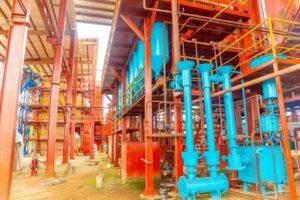
 Nigeria has struck a gas-supply agreement for its long-idle Ajaokuta Steel Company, a step officials say brings the West African nation closer to reviving a plant that has swallowed more than $8 billion in public money over five decades without ever rolling a single coil of steel.
Under the arrangement, up to 50 million standard cubic feet of gas a day will feed a power plant that services the sprawling metals complex on the banks of the Niger River, about 200 kilometers south of Abuja.
For years, the absence of a reliable gas supply has been the single biggest obstacle cited by would-be investors, according to Nasir Naeem Abdulsalam, the plant’s managing director.
“We have had several different investors across different countries ask the same question: ‘How do we get the supply of gas?’” Abdulsalam said. “Without gas, you can’t operate the steel plant. You can’t operate the independent power generation that we have there. The steel plant and all its components are all powered by gas.”
Abdulsalam was appointed to lead the turnaround effort in April 2025, inheriting a project that has become shorthand in Nigeria for state waste.
Conceived in 1979 and built with Soviet backing, Ajaokuta was designed to produce as much as 5 million tons of steel annually, drawing on Nigeria’s substantial iron-ore reserves to wean Africa’s most populous economy off its heavy reliance on crude-oil exports. Instead, the furnaces have sat cold for the better part of 50 years.
The stakes have risen under President Bola Tinubu, who has pushed a broad economic overhaul since taking office in 2023 and has set a target of 10 million tons of annual crude-steel output by 2030, a goal that is difficult to reach without Ajaokuta running.
There are, at least, small signs of activity on site. Engineers have built a modular blast furnace that is now turning out manhole covers, utility poles and rail-track components for a limited domestic market, even as the plant’s main furnaces remain dormant.
Rather than pursue outright privatisation, the government has settled on a strategy of bringing in partners to operate and finance the complex over a 10-to-15-year term, with returns flowing back to the state, an approach modeled on Nigeria’s push to revive its long-troubled oil refineries.
“All options are on the table,” Abdulsalam said, but that build-operate-style structure is now the preferred path.
He said prospective investors from the US and China have already conducted technical assessments of the site, though he declined to name them.
Their conclusion, he said, is that the blast furnaces could be brought back online within six to seven months, with the rest of the facility, rolling mills, ancillary plants and supporting infrastructure, following over two to three years.
Ajaokuta has burned through investor goodwill before. Russian firms, including Tyazhpromexport, the original builder, have twice attempted revivals that went nowhere. Japan’s Kobe Steel Ltd. and India’s Ispat Industries Ltd. also walked away empty-handed.
Yusuf Ochejah, secretary general of the country’s metallurgical society and a former assistant director at the plant, dismissed the latest optimism.
“It’s all noise,” said Ochejah, who trained in Russia, told Bloomberg.
He said the blast-furnace system has never actually operated and the steel-making section has never been tested, meaning any new investor would effectively be starting from an unproven industrial base rather than a mothballed but functional plant. “Any potential investor will have to put in so much resources to get anything out,” he said.