

 Pecohub
Nile University of Nigeria has inducted 261 graduates of its Faculty of Engineering into the Nigerian Society of Engineers (NSE) and administered the Council for the Regulation of Engineering in Nigeria (COREN) oath in its maiden Induction and Oath-Taking Ceremony, as the institution intensifies efforts to align its programmes with international standards.
The ceremony marks a significant milestone for the University’s Faculty of Engineering, which was established in 2009 and has grown into one of its flagship academic units, offering programmes in Civil Engineering, Computer Engineering, Electrical and Electronics Engineering, Mechanical Engineering, Mechatronics Engineering, and Petroleum and Gas Engineering.
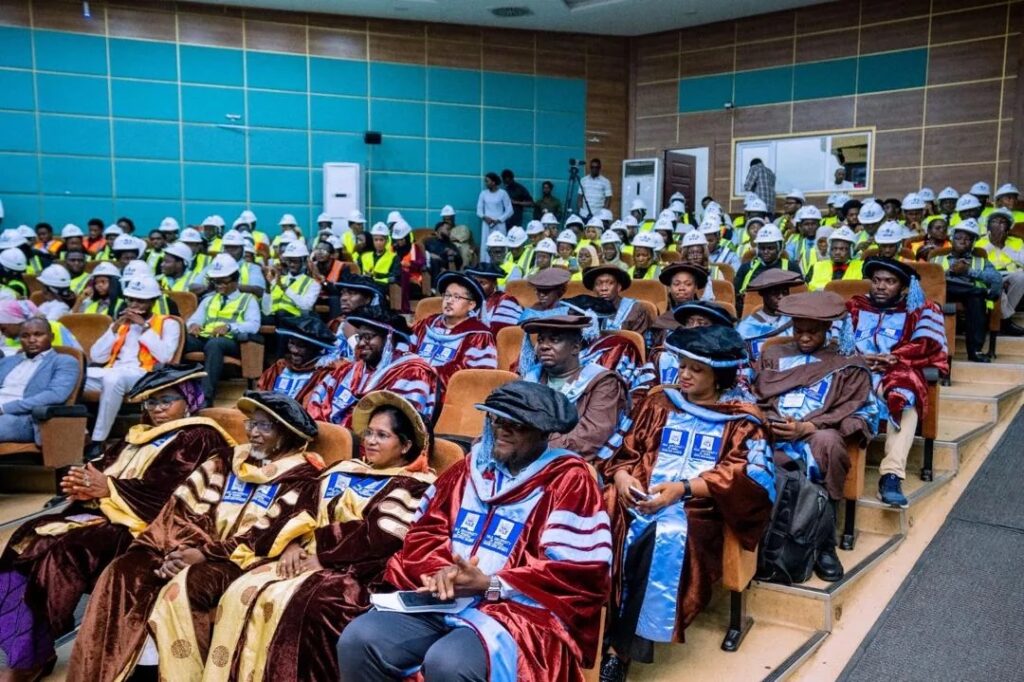
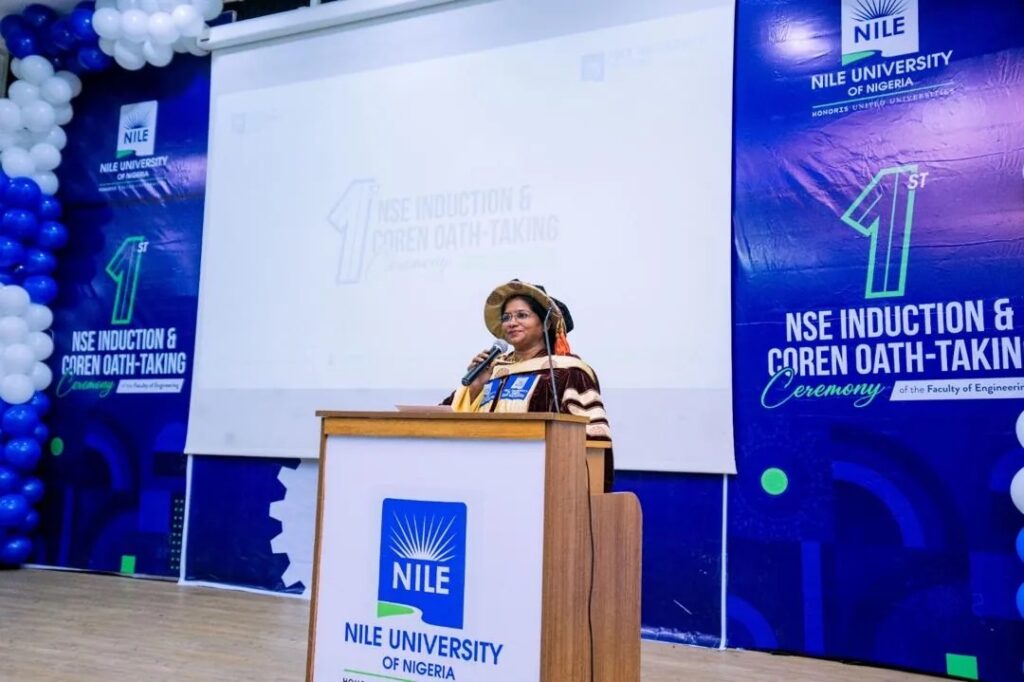
Prof. Prema A. Kirubakaran, who represented the Vice-Chancellor, described the ceremony as a landmark achievement for the Faculty and urged the newly inducted engineers to uphold the values of integrity, responsibility and continuous learning throughout their careers.
Delivering the keynote address, Engr. Dr. Adamu Muhammed, MNSE, MNSChE, PMP, AMIChemE, Terminal Manager, NNPC Limited, praised Nile University of Nigeria for its contribution to engineering education, describing the institution as one capable of standing alongside leading universities globally.
He challenged the new engineers to remain honest, continue learning and apply their knowledge to solving Nigeria’s developmental challenges. He urged the graduates to build careers defined by innovation, discipline and professional excellence.
Speaking at the ceremony, Engr. Prof. Okorie Austine Uchegbusi Uche, FNSE, Registrar of COREN, commended Nile University of Nigeria for its implementation of Outcome-Based Education (OBE), describing it as one of the few institutions in the country actively applying the approach, which emphasises measurable competencies and graduate outcomes.
Reflecting on the significance of the occasion, the Dean of the Faculty of Engineering, Engr. Prof. Abdulhameed Danjuma Mambo, said the induction signified the graduates’ readiness to assume the responsibilities of professional engineering practice.
“Graduation shows that you have learned, but induction shows that you have become a professional,” he said.
According to him, while members of the public may never see the calculations behind engineering projects, they place their trust in the professionalism and judgment of engineers responsible for them.
Prof. Mambo said the Faculty remains committed to producing graduates equipped with the technical knowledge, professional values and practical skills required to contribute to national development. He noted that the ongoing accreditation activities involving the Faculty form part of efforts to ensure that its programmes meet global standards and remain competitive internationally.
The induction also provided an opportunity to recognise academic excellence among the graduating class. Those honoured included Abdulfattah Abdulsallam of Computer Engineering and Melissa Oma Ekuma of Petroleum and Gas Engineering. Others recognised were Adumein Ayibaingo Adumien of Civil Engineering, Divine Ofure Okose of Mechatronics Engineering, Muhammed Sani Dahiru of Electrical and Electronics Engineering, and Thama Bakari Wadinga of Mechanical Engineering.
The induction and oath-taking ceremony comes at a time when the Faculty is pursuing greater international recognition. Recently, Nile University of Nigeria hosted officials of the Council for the Regulation of Engineering in Nigeria (COREN) and international experts from the International Engineering Alliance (IEA) for an accreditation exercise on its Mechanical Engineering and Petroleum & Gas Engineering programmes. The exercise forms part of Nigeria’s broader alignment with the Washington Accord framework, which promotes internationally recognised standards for engineering education and professional preparation.
University officials believe the accreditation exercise will further strengthen the quality and global competitiveness of the Faculty’s programmes while enhancing opportunities available to future graduates. For the institution, the exercise reflects a broader commitment to producing engineers who are creative, innovative and equipped to develop practical solutions to national and global challenges.
For Nile University of Nigeria, the induction of 261 new engineers represents more than a ceremonial milestone. It signals the emergence of a Faculty increasingly positioning itself at the intersection of professional excellence, industry relevance and internationally benchmarked engineering education.