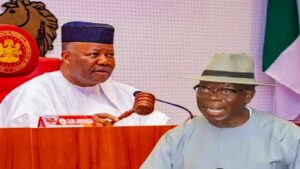

From Government Houses to Senate: Nine Governors Weigh 2027 Bids
 Pecohub
 Nine serving governors are positioning themselves for the Senate ahead of the 2027 elections, reviving a political route that has become increasingly common among state governors seeking to remain influential after leaving office.
The governors are Abdullahi Sule of Nasarawa, Bala Mohammed of Bauchi, Douye Diri of Bayelsa, Dapo Abiodun of Ogun, Ahmadu Fintiri of Adamawa, Mai Mala Buni of Yobe, Inuwa Yahaya of Gombe, AbdulRahman AbdulRazaq of Kwara and Hope Uzodimma of Imo.
Their expected entry into the senatorial race is already altering the political calculations in their states, with some incumbent senators likely to face difficult contests as governors seek new platforms from which to sustain their influence.
The 10th National Assembly already has a significant presence of former governors. They include Senate President Godswill Akpabio, Danjuma Goje, Ibrahim Dankwambo, Abubakar Sani Bello, Seriake Dickson, Gbenga Daniel, Orji Uzor Kalu, Adams Oshiomhole, Adamu Aliero, Abdulaziz Yari, Aliyu Wamakko and Simon Lalong.
For several of them, the move from Government House to the Red Chamber was almost seamless.
Goje, who governed Gombe State between 2003 and 2011, entered the Senate after completing his tenure and has remained in the chamber.
Akpabio followed a similar route after governing Akwa Ibom between 2007 and 2015. He became a senator in 2015, later emerged as Senate Minority Leader and subsequently served as Minister of Niger Delta Affairs before returning to the Senate in 2023. He is now the Senate President.
Aliero, a former Kebbi governor, also has an extensive history in the chamber. He entered the Senate in 2007 and left after his appointment as a minister under the Umaru Musa Yar’Adua administration.
Others, including Yari, Lalong, Sani Bello, Oshiomhole and Daniel, are serving their first terms in the 10th Senate.
Former governors Dave Umahi of Ebonyi and Ibrahim Gaidam of Yobe also secured Senate seats after leaving office but later relinquished them following their appointments as ministers.
The practice predates the current National Assembly.
Vice President Kashim Shettima moved from the Borno Government House to the Senate before eventually becoming vice president. Other former governors who have served in the Senate include George Akume and Gabriel Suswam of Benue; Chimaroke Nnamani of Enugu; Theodore Orji and Orji Uzor Kalu of Abia; Joshua Dariye and Jonah Jang of Plateau; Sani Yerima of Zamfara; Ahmed Makarfi of Kaduna; Bukola Saraki of Kwara; Tanko Al-Makura and Abdullahi Adamu of Nasarawa.
The attraction of the Senate for outgoing governors is largely political.
After eight years of exercising considerable influence within their states, a Senate seat provides an avenue to remain visible in national politics, participate in federal decision-making and retain influence within their political parties.
But as the number of former governors in the legislature grows, questions are also being raised about whether executive experience has translated into effective parliamentary performance.
Being a former governor does not automatically make a senator an active legislator. The constitutional responsibilities of lawmakers extend beyond sponsoring bills to include debates, committee work, constituency representation and oversight of public institutions and government spending.
The record of former governors in the Senate has therefore produced a mixed picture.
In the 10th Senate, Akpabio, Aliero, Dickson, Oshiomhole, Kalu, Lalong, Daniel and Goje have been identified as among those who have participated more visibly in legislative proceedings, while others have attracted criticism over limited participation in plenary and debates.
Bill sponsorship figures have similarly varied.
A 2024 review found that 24 of the 109 senators had not sponsored a bill within the period examined. Four of the 13 former governors in the chamber at the time, Oshiomhole, Dickson, Lalong and Yari, were among those without a bill recorded during the period. Some subsequently sponsored legislation.
Kalu had five bills, Daniel four, while Dankwambo and Sani Bello had three each. Akpabio, Goje and Wamakko had two apiece, while Aliero and Tambuwal had one each.
However, legislative productivity cannot be reduced to the number of bills introduced.
A senator may sponsor several bills that never progress beyond the early stages of the legislative process, while another could have a smaller number of bills but play significant roles in committees, oversight activities, investigations and debates.
An earlier assessment of the ninth National Assembly by OrderPaper Nigeria illustrated the point. Its review of legislative activity between June 2019 and May 2021 found that only nine of the 17 former governors in the Senate had sponsored at least five bills during their first two years.
Former Kano governor Ibrahim Shekarau had not sponsored a bill, while Chimaroke Nnamani sponsored one. Aliero, Gaidam and Goje had two each.
Former Ogun governor Ibikunle Amosun led the former governors in bill sponsorship but did not rank on the productivity index that considered how far legislation progressed through the legislative process.
The broader lesson is that introducing legislation is only the beginning. Bills have to survive committee scrutiny, receive reports, return to plenary and eventually secure passage.
Political analyst and public affairs commentator Dele Oyedeji said the attraction of the Senate for outgoing governors should be viewed largely through the lens of political continuity.
According to him, “governors who have spent years building political structures are unlikely to simply withdraw from the political arena once their tenure ends.
“The Senate gives them a recognised national platform from which they can continue to participate in politics and influence important decisions.”
Oyedeji, however, said a Senate seat was not necessarily the only route through which a former governor could remain relevant.
He argued that many former governors could continue to exercise considerable influence through their political parties, networks and other positions outside the legislature.
He added, “The bigger question, he said, should therefore be whether those who seek Senate seats are prepared to make the transition from executive leadership to the very different demands of parliamentary work.”
For Auwal Musa Rafsanjani, Executive Director of the Civil Society Legislative Advocacy Centre and Chairman of the Transition Monitoring Group, the trend raises concerns beyond the individual ambitions of former governors.
Rafsanjani said repeated movement by the same political figures from one elective position to another could narrow the space available to new entrants into politics.
He argued that democratic institutions benefit when leadership is regularly renewed and when political parties provide opportunities for younger politicians, women and professionals with demonstrable capacity.
Rather than automatically rewarding political prominence, Rafsanjani said candidates should be subjected to closer scrutiny of their records in previous offices.
He questioned the wisdom of former governors immediately seeking fresh elective positions when the performance of their administrations may still require public evaluation, particularly in states dealing with poverty, unemployment, insecurity, infrastructure deficits, healthcare challenges and weak educational outcomes.
In his view, the issue is not that former governors are constitutionally barred from seeking legislative office, but that voters and political parties should demand evidence of competence and accountability before supporting them.
“Instead of being subjected to rigorous public accountability and performance evaluation, they often retain political influence through party structures, financial power and patronage networks,” he added.
Rafsanjani also warned that when political office repeatedly circulates among a relatively small group, citizens may begin to view politics as an exclusive preserve of established elites.
“The Senate and other legislative institutions should not become retirement platforms for political office holders. Legislative positions require competence, independence, integrity, and a strong commitment to lawmaking and oversight responsibilities,” Rafsanjani said.
Professor Abubakar Kari, a political sociologist at the University of Abuja, took a more critical view of the development, linking the former governors’ attraction to the Senate to what he described as wider weaknesses within Nigeria’s legislative system.
Kari said the real issue was not simply that former governors were contesting Senate seats, but what they intended to do once elected.
He argued that lawmakers have three core responsibilities legislation, representation and oversight and questioned whether some senators were giving sufficient attention to those functions.
According to him, poor attendance at plenary and committee proceedings, weak engagement with constituents and limited contributions to debates undermine the purpose of legislative representation.
Kari said the situation was particularly worrying because the legislature should serve as one of the strongest mechanisms for holding the executive accountable.
He also criticised what he described as the poor attendance and limited constituency engagement of some lawmakers, saying several legislators had effectively become absentee representatives.
“First and foremost, it is important to note that the major functions of the legislature are lawmaking, representation and oversight, but you hardly see these people. They usually claim that attending plenary is just one of the major things they do. But the problem is that they hardly do any representation. In fact, they avoid their constituencies.
“Some of them simply open offices, put some aides there and you hardly see them. These are more or less absentee legislators; they just turn the whole thing into convenience. And nobody sanctions them. In fact, there has never been an attempt to sanction anybody,” he said.
Kari further questioned the incentive structure within the National Assembly, arguing that lawmakers continued to receive their remuneration regardless of their level of participation.
“Secondly, they still collect their pay, whether they attend or not; they collect hefty pay. The main attraction is the pay. They also cut all sorts of deals, particularly during oversights,” he said.
For Kari, this helps explain why the Senate can become attractive to some former governors even when legislative work may not be their primary interest.
He described the chamber as a convenient political destination for some former governors, arguing that their motivation could sometimes be more about preserving influence and securing a political base than making laws.
The professor said the consequences extend beyond individual legislators.