
Akpabio Accused of Frustrating Creation of Proceeds of Crime Agency After Senate Rescinds Bill
 Pecohub
 The Senate President, Godswill Akpabio, has been accused of frustrating the creation of a proposed Proceeds of Crime (Recovery and Management) Agency after the Senate rescinded its earlier passage of the Bill seeking to establish the institution.
The accusation followed the Senate’s decision to reverse its July 9, 2026 passage of the Proceeds of Crime (Recovery and Management) (Amendment) Bill, 2026, after lawmakers had earlier adopted the report of the Senate Committee on Judiciary, Human Rights and Legal Matters, which recommended the creation of a standalone agency.
The Bill, sponsored by Senator Idiat Adebule, representing Lagos West, had passed through first and second readings, committee scrutiny, a public hearing, consideration by the Committee of the Whole, approval of all 51 clauses and third reading before the Senate Leader, Michael Opeyemi Bamidele, representing Ekiti Central, moved the motion for its rescission.
Sources who asked not to be named told SaharaReporters that Bamidele’s move was allegedly orchestrated by Akpabio to frustrate the establishment of the agency.
“The bill had gone through all the processes involved to ensure establishment of the agency, infact, the whole Senate approved it, it went through first reading, second reading,third reading, even the committee on legal matters and judiciary examined it, just for the Senate leader to want to frustrate the efforts by quickly packaging a rescission bill,” a source told SaharaReporters.
The rescission has overturned the Senate’s July 9 approval. Consequently, the proposed agency no longer has the legislative passage it secured on that date and the Bill would have to be reconsidered and passed again before the proposed institution can proceed on the basis of the legislation.
The development is significant because the proposed agency was not introduced at the final stage of the legislative process. Its establishment was the central objective of a Bill that had undergone extensive committee scrutiny and stakeholder engagement.
The Senate Committee on Judiciary, Human Rights and Legal Matters had recommended the establishment of a standalone Proceeds of Crime (Recovery and Management) Agency to replace an existing framework under which asset recovery and management responsibilities are dispersed across at least 18 separate agency-based directorates.
According to the committee’s report, a copy of which was seen by SaharaReporters, the Bill sought to transition the existing structure under the Proceeds of Crime (Recovery and Management) Act, 2022, to a single institution with corporate legal personality, perpetual succession and a centralised mandate for the recovery, preservation and disposal of properties reasonably suspected to have been derived from unlawful activities.
The committee’s recommendation followed a public hearing held on February 26, 2026, at the National Assembly Complex, Abuja.
The committee had reportedly advertised the Bill in national newspapers and received memoranda from 22 organisations and individuals, including law enforcement and regulatory institutions, professional organisations and civil society groups.
Those that submitted memoranda were said to have included the Economic and Financial Crimes Commission (EFCC), Independent Corrupt Practices and Other Related Offences Commission (ICPC), National Drug Law Enforcement Agency (NDLEA), Department of State Services (DSS), Code of Conduct Bureau, National Human Rights Commission, Nigerian Bar Association and Transparency International Nigeria.
The Nigerian Law Reform Commission, Policy and Legal Advocacy Centre, Socio-Economic Rights and Accountability Project, Civil Society Legislative Advocacy Centre and other organisations also made submissions.
The committee subsequently considered the memoranda and evidence presented at the public hearing before arriving at its observations, findings and recommendations.
Significantly, Bamidele, who later sponsored the motion to rescind the Senate’s July 9 passage, according to documents seen by SaharaReporters, was himself a member of the Senate Committee on Judiciary, Human Rights and Legal Matters that scrutinised the Bill and recommended the establishment of the agency. The committee’s endorsement page lists “Senator Michael Opeyemi Bamidele,CON” as a member alongside its chairman, Senator Adegbonmire Adeniyi Ayodele, SAN, and other members. His membership of the committee means he was part of the legislative body that considered the Bill before it was presented to the Senate for passage and subsequently moved for the rescission of that approval.
A source told SaharaReporters that it was strange if Bamidele did not stand against the bill at the Committee level or expressed his worry on the floor of the Senate, instead waiting till completion of all processes.
When the Bill came before the Senate on July 9, lawmakers considered the committee’s report clause by clause and approved all 51 clauses.
Clause 2 specifically provided for the creation of the proposed agency.
It stated: “There is established a body to be known as the Proceeds of Crime (Recovery and Management) Agency.”
The agency was to be “a body corporate with perpetual succession and a common seal” and empowered to sue and be sued in its corporate name.
The Bill also empowered it to “acquire, hold and dispose of movable and immovable property” for the purposes of performing its statutory functions.
Its headquarters was designated to be in the Federal Capital Territory, Abuja, with powers to establish zonal offices in any state of the federation where necessary.
The legislation further set out the agency’s objectives, including providing “an effective legal and institutional framework for the recovery and management of the proceeds of crime, in accordance with due process and the rule of law.”
It also provided for the restraint, seizure, confiscation and forfeiture of property derived from unlawful activities and instrumentalities used or intended to be used in committing such offences.
Another major provision was the introduction of a non-conviction-based procedure for the recovery of proceeds of crime.
The Bill further sought to strengthen criminal confiscation procedures by ensuring that the total benefit derived from a person’s criminal activity is calculated and an equivalent amount, where recoverable, is confiscated on behalf of the Federal Government.
The proposed agency would also have responsibility for managing recovered assets and property and facilitating collaboration among relevant organisations involved in tracing and forfeiting properties reasonably suspected to be proceeds of unlawful activity.
The July 9 proceedings show that the Bill received approval at multiple stages.
At the conclusion of the clause-by-clause consideration, the President of the Senate reported that the Committee of the Whole had considered the report of the Judiciary, Human Rights and Legal Matters Committee and approved “Clauses 1-51 As Recommended.”
The Senate subsequently approved the report of the Committee of the Whole.
Bamidele, who later sponsored the motion to rescind the passage, had himself moved that the Bill be read for the third time before the motion for its passage to become an Act was put to the Senate and agreed to.
The official record thereafter stated: “Bill accordingly Read the Third Time and Passed.”
The passage followed the earlier adoption of the committee’s recommendation for the establishment of the agency.
The Bill’s legislative journey had started earlier, with the Senate considering its general principles on November 13, 2025, before referring it to the Judiciary, Human Rights and Legal Matters Committee for further legislative action.
At the public hearing, the committee chairman, Senator Adegbonmire Adeniyi Ayodele, SAN, said the committee approached the exercise with an open mind and was committed to receiving different perspectives before reaching a considered legislative position.
Senator Mohammed Tahir Monguno, who represented the Senate President at the opening of the hearing, described the management of proceeds of crime as a critical issue in Nigeria’s anti-corruption architecture.
He commended the committee for subjecting the Bill to broad stakeholder engagement and described the proposed amendment as a “bold legislative step” towards addressing longstanding structural inefficiencies in asset recovery and management.
Despite the July 9 passage, Bamidele subsequently sponsored a motion seeking to rescind the Senate’s decision. A copy of the motion was seen by SaharaReporters.
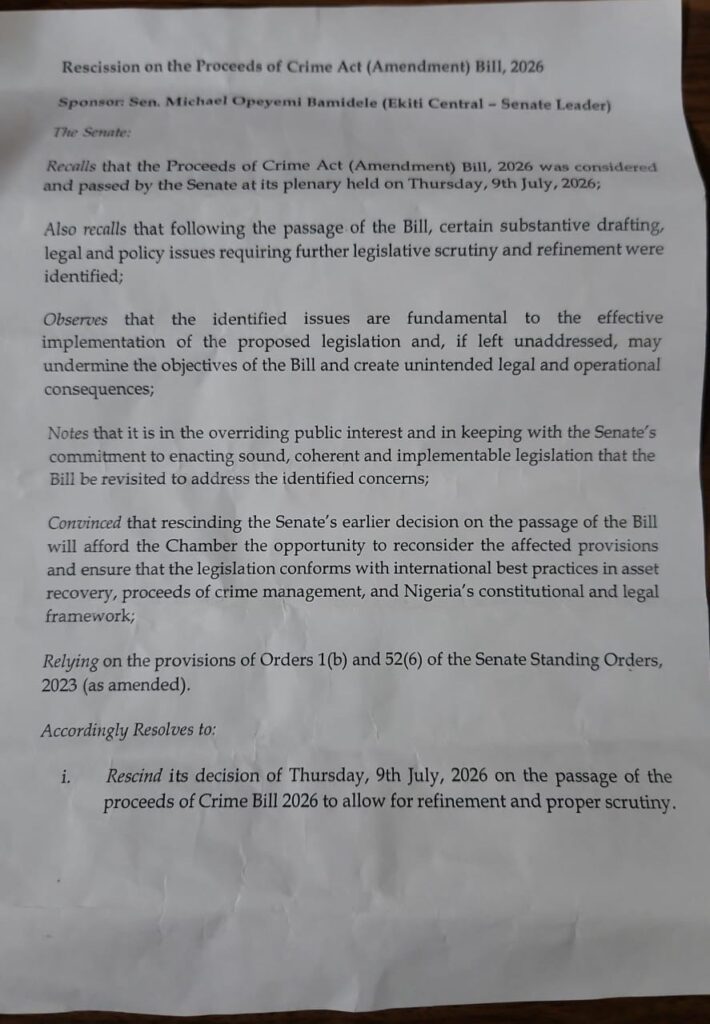
The motion expressly acknowledged the earlier passage, stating that the Senate “recalls that the Proceeds of Crime Act (Amendment) Bill, 2026 was considered and passed by the Senate at its plenary held on Thursday, 9th July, 2026.”
It then stated that after the passage, “certain substantive drafting, legal and policy issues requiring further legislative scrutiny and refinement were identified.”
According to the motion, those issues are fundamental to effective implementation and, if left unresolved, could “undermine the objectives of the Bill and create unintended legal and operational consequences.”
The motion argues that revisiting the Bill is in the “overriding public interest” and is consistent with the Senate’s commitment to enacting sound, coherent and implementable legislation.
Sources told SaharaReporters that during the processes that led to the passage of the Bill, including consideration at committee level, Bamidele had opportunities to raise observations but allegedly waited until the legislative process had been completed.
“What exactly are they scared of, the overriding public interest could have stopped the bill from being passed but it went through all stages and suddenly they now came with some excuses to wield their power,” another source told SaharaReporters.
The motion presented by Bamidele further states that rescinding the earlier decision would allow the chamber to reconsider the affected provisions and ensure that the legislation conforms with international best practices in asset recovery and proceeds of crime management, as well as Nigeria’s constitutional and legal framework.
Relying on Orders 1(b) and 52(6) of the Senate Standing Orders, 2023, as amended, the motion resolved to “Rescind its decision of Thursday, 9th July, 2026 on the passage of the proceeds of Crime Bill 2026 to allow for refinement and proper scrutiny.”
Documents seen by SaharaReporters and the public statements subsequently made by the Nigerian Senate did not reveal the exact issues found with the Proceeds of Crime(Recovery and Management) Act, that was earlier passed, instead stating that the issues were legal and of public interest.
The rescission has changed the legislative status of the proposed agency.
Although the Senate had approved its creation as part of the July 9 passage, that decision has now been overturned. The proposed agency therefore cannot rely on the earlier passage as the legislative basis for its establishment.
The Bill was also designed to provide a clearer framework for asset recovery, non-conviction-based forfeiture, confiscation and management of properties forfeited to the Federal Republic of Nigeria.
Sources who asked not to be named told SaharaReporters that the rescission was a setback to efforts to establish a centralised system for managing recovered assets in Nigeria.
“You see a case where assets are seized and suddenly you can’t get to know how they are managed, one would have expected the Senate President Akpabio and Senate leader, Bamidele to be eager to get the agency working but that’s not the case,” another source told SaharaReporters.
Earlier in July, the Economic and Financial Crimes Commission Chairman, Ola Olukoyede, described the Proceeds of Crime Act, now rescinded, as a laudable move in the fight against corruption.
By rescinding its July 9 decision, the Senate has effectively withdrawn its earlier approval of the proposed framework, leaving the agency without the legislative passage it had secured and preventing the July 9 decision from taking effect unless the Bill is reconsidered and passed again.
When the spokesperson for Godswill Akpabio, Eseme Eyiboh, was contacted, he declined comments, noting that the issue of the rescission was one “bothering on the Nigerian Senate” and that he could not speak on the allegations against his boss, the Senate President.
When Eyiboh was requested to comment on the allegations specifically against the Senate President, Akpabio, which he was alleged to have influenced the Senator Bamidele decision to move a bill rescinding the agency, he did not reply as of the time of filing this report.