
Trump Wants To ‘Rebuild Gaza’ But Avoids Stance On Palestinian State
 Pecohub
 Donald Trump told world leaders the hardest part is over – but key parts of his 20-point peace plan remain unsettled.
Not least, Hamas and Israel have not agreed on the details of Gaza’s postwar governance, the territory’s reconstruction and Israel’s demand that Hamas disarm.
Negotiations over those issues could break down, and Israel has hinted it may resume military operations if its demands are not met.
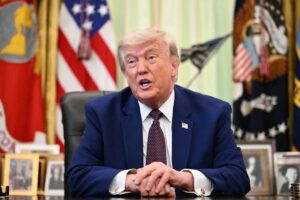
As Palestinians returned to the rubble where their homes once stood, Trump declared yesterday: “Rebuilding is maybe going to be the easiest part. I think we’ve done a lot of the hardest part because the rest comes together.”
Others were more tentative about the intricacies that lie ahead.
“Unfortunately, I think there are several potential points of failure going forward,” said Mona Yacoubian, director of the Middle East Program at the Center for Strategic and International Studies.
Unanswered questions
How and when Hamas is to disarm, and where its arms will go, are unclear, as are plans for Israel’s withdrawal from Gaza.
A new security force is to be established for Gaza, made up of troops from other nations, but it is not known which countries will send forces, how they will be used and what happens if they encounter resistance.
It’s also not clear who will staff a temporary governing board for Gaza, where it will be located and how the population will respond.
And rebuilding Gaza would cost $53bn, according to The World Bank, the United Nations and the European Union.
All of that is layered atop a legacy of conflict, deep distrust among the sides and a vague, conditional possibility of an eventual Palestinian state – an issue that has been a core sticking point for decades.
“When you realise how far things have to go for that current pause to be sustained, that’s where I think it does become very daunting,” Yacoubian said.
It was an extraordinary day of enormous emotion and high drama, but, for all that, we have only witnessed the first phase of the Trump peace plan – and in many ways that is the easy bit.
The first phase envisaged a ceasefire, the release of hostages, the release of many more Palestinians held in Israeli jails, a partial Israeli military withdrawal, and aid starting to flood back into Gaza.
Job done, although the aid bit is still a work in progress.
Trump and his team ripped up one of the golden rules of Middle Eastern negotiating to pull this off: No deal until a final deal.
They have turned that on its head, pushing for a breakthrough on what can be agreed on, and then committing to sorting out the rest later.
And it’s worked in the sense that it has delivered a spectacular day of achievements. The catch is it has postponed the harder bits, which now loom into view.
They include what happens to Hamas and whether it should be disarmed, creating a transitional authority to govern Gaza, and sending in a multinational peacekeeping force to provide security. There are plans for a “board of peace” to oversee everything, chaired by Donald Trump.
If there is progress on all of that, the Israeli military withdrawal is committed to withdraw further back to a narrow buffer on the edges of Gaza’s border. And ultimately, the hope is of continued momentum towards talks about Palestinian statehood and a “two-state solution”.
Donald Trump made it abundantly clear he believes this is only the start. This is, he said, the historic dawn of a new Middle East”. There seem few limits to his peacekeeping ambition.
But if the diplomacy is going to fulfill the promise of his rhetoric, there must be progress on at least the security force and the transitional government for Gaza.
Because without that, the vacuum left by the retreating Israeli military could soon be filled by Hamas. It could then, in due course, rally, regroup, and at some point return to the fray.
The president has gathered together an impressive coalition of countries in Sharm, on the face of it, committed to his 20-point plan. He must now harness them to give Gazans an alternative vision they can believe in. Without it, his ambitious rhetoric remains just that.